
From Ghosh to Bikram to Progressive Hatha Yoga
When we walk into a yoga room and practise the same sequence week after week, it is easy to forget that the postures have a history.
The 26/2 sequence practised today did not suddenly appear with Bikram Choudhury. It belongs to a much larger story of Indian Hatha Yoga, physical culture, therapeutic movement and generations of teachers.
And Progressive Hatha Yoga, or PHY, continues that story in another direction.
It begins in India
One of the important names in our story is Bishnu Charan Ghosh, born in 1903.
Ghosh was the younger brother of Paramahansa Yogananda, the Indian yogi who later became internationally known through his book Autobiography of a Yogi.
Their approaches eventually became quite different.
Yogananda became particularly known for meditation, Kriya Yoga and spiritual practice.
Bishnu Ghosh became deeply interested in the physical body.
He explored Hatha Yoga, strength, muscular control, physical culture and the therapeutic use of movement.
His school in Kolkata became known for an approach to yoga that was both physical and practical. Students were not simply learning beautiful postures. Yoga was also being explored as a way of developing and restoring the body.
Ghosh Yoga was much bigger than 26 postures
This is where the story becomes particularly interesting for students of 26/2.
The Ghosh tradition never consisted of only 26 postures.
Historical research into books written by Ghosh and several of his students has identified more than 100 different postures, together with numerous therapeutic exercises.
Among Ghosh's important students were teachers such as Buddha Bose, Gouri Shankar Mukerji, Monotosh Roy and others.
Different students worked with different postures, exercises and therapeutic approaches.
There was a much larger toolbox.
Some of the postures familiar to students of 26/2 can also be found in very old Hatha Yoga texts. Cobra, Locust, Bow, Head to Knee, Stretching, Spinal Twist and Savasana are examples of postures with much older roots.
Others developed much more recently.
Yoga has always evolved.
Then came Bikram Choudhury
Bikram Choudhury trained in Kolkata in the tradition associated with Bishnu Ghosh.
He later moved abroad and, during the 1970s, organised a group of postures into what became known as Bikram's Beginning Yoga Class.
The format became remarkably simple:
26 postures.
2 breathing exercises.
The same sequence.
Every class.
Over time, the heated room also became one of its defining characteristics.
This fixed sequence is one reason the method became so successful. A beginner could practise beside an experienced student. You did not need to know what was coming next. With repetition, the sequence slowly became familiar.
And then something interesting happened.
Because the sequence stayed the same, the student changed.
Why repetition matters
Anyone who has practised 26/2 for some time knows this experience.
You may have done Triangle hundreds of times.
But Triangle is not always the same.
One day your balance changes.
Another day your hip opens slightly more.
Another day the posture feels terrible.
Then suddenly something you have been working on for months becomes possible.
The sequence provides the structure.
Your body provides the progression.
This is one of the great strengths of the 26/2 practice.
But Bikram is only one branch of the tree
It is important to understand that Bikram Yoga is not the whole Ghosh tradition.
It is one system that grew from it.
Historical material connected with the Ghosh lineage contains far more postures and therapeutic exercises than those found in the 26/2 sequence.
Even some postures we strongly associate with Bikram developed relatively recently. Historical research, for example, has found no Standing Bow in the major early Ghosh texts. The posture appears to have entered the tradition later.
This does not make the posture less valuable.
It simply reminds us that yoga is a living tradition.
Teachers learn.
Students experiment.
Knowledge develops.
Methods change.
Enter Dev Kapil and Amrei Marden
Our own teaching at Sun Connexion has also been strongly influenced by Master Dev Kapil and Amrei Marden.
Dev Kapil, founder of Progressive Hatha Yoga, comes from a lineage deeply rooted in traditional Indian knowledge. He began his yogic journey in India at the age of three under the guidance of his father, Shri M. R. Pareek, continuing a family legacy passed down through his grandfather, Yogiraj Rishikesh Shastri, a renowned astrologer and Vedic scholar. His spiritual training was later initiated under Guru Veet Raag Tapomurti Brahmrishi Danditt Swami Laksheshwarashramji. Dev went on to study Yogic Science, naturopathy, therapeutic yoga, Ayurveda, astrology and other areas of traditional Indian knowledge. He has spent more than two decades teaching internationally and has trained thousands of yoga teachers.
Amrei Marden brings another important part of this lineage. She has practised Bikram Yoga since 2001 and has taught thousands of classes, private sessions and posture workshops. She has also coached and judged yoga competitors in Australia and internationally and has been closely involved in Bikram Yoga teacher training alongside Dev.
Together, Dev and Amrei bring two complementary strengths to the practice.
Amrei carries a deep understanding of the traditional 26/2 method, its precision, discipline and posture refinement.
Dev brings that strong Bikram foundation together with a much wider exploration of Hatha Yoga, yoga therapy and progressive posture development.
This is important because Progressive Hatha Yoga is not simply another name for Bikram Yoga.
It opens the door to a much larger world of Hatha Yoga, while still keeping the discipline, structure and attention to detail that are so central to the 26/2 practice.
What is Progressive Hatha Yoga?
Progressive Hatha Yoga asks a very simple question:
What might your body be capable of if you continue developing it?
Instead of stopping with one fixed sequence, the practice introduces a much wider range of postures and variations.
The PHY training system works with the traditional concept of 84 Hatha Yoga postures and uses progressive development, preparation and hands-on teaching to help students move towards increasingly demanding postures.
The word progressive is important.
You are not expected to arrive on your first day and perform an advanced posture.
You build towards it.
Strength develops.
Mobility develops.
Balance develops.
Body awareness develops.
And sometimes the posture that looked completely impossible becomes possible.
26/2 and PHY are wonderful companions
This is perhaps the easiest way to understand the two practices.
26/2 gives us repetition.
PHY gives us exploration.
26/2 says:
"Here is the sequence. Now observe how you change."
PHY says:
"Here is where you are today. Now let us discover where you can go."
They are different approaches, but they complement each other beautifully.
The discipline and foundation created through 26/2 can prepare the body for a wider Hatha Yoga practice.
PHY can then introduce new movements, new challenges and new possibilities.
A living lineage
There is no need to imagine yoga as something that was created once, thousands of years ago, and then remained unchanged.
The history is far more interesting than that.
Ancient Hatha Yoga practices influenced later teachers.
Indian physical culture influenced modern yoga.
Bishnu Ghosh developed his own approach.
His students continued developing it.
Bikram Choudhury organised 26 postures into a fixed beginning sequence.
Later teachers continued exploring the wider possibilities of Hatha Yoga.
And teachers such as Dev Kapil continue that process today through Progressive Hatha Yoga.
The tradition is alive because people continue to practise it.
Every time we enter the yoga room, we become another small part of that story.
We practise what previous generations discovered.
We learn what our own body has to teach us.
And then we pass that knowledge forward.
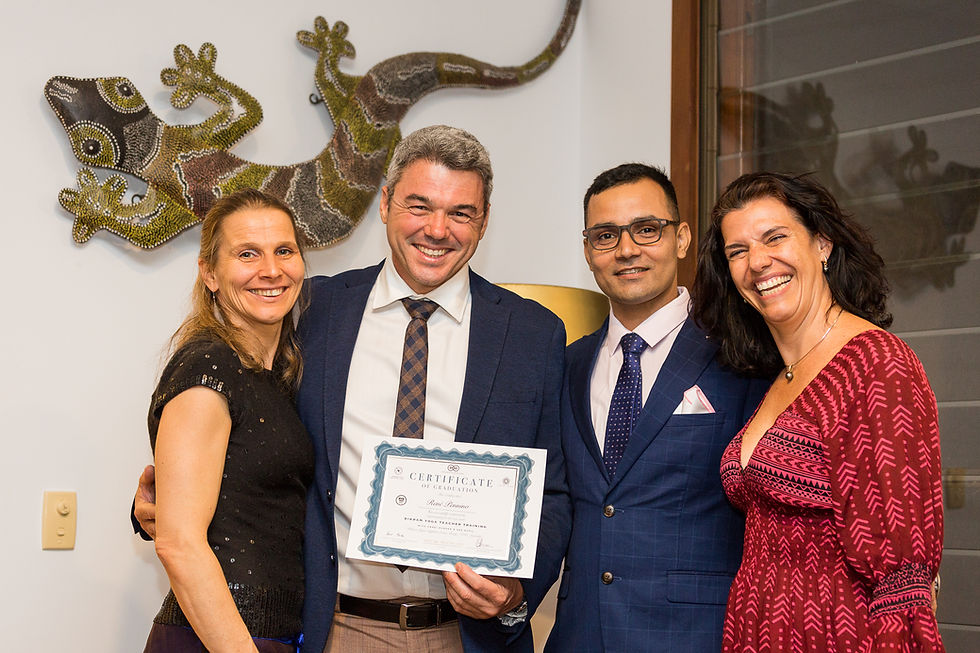
Gradution Teacher Training Nov 2025 - from Left to Right : Amrei Marden, Rene Pennino, Dev Kapil & Belen Lopez Denis


Comments